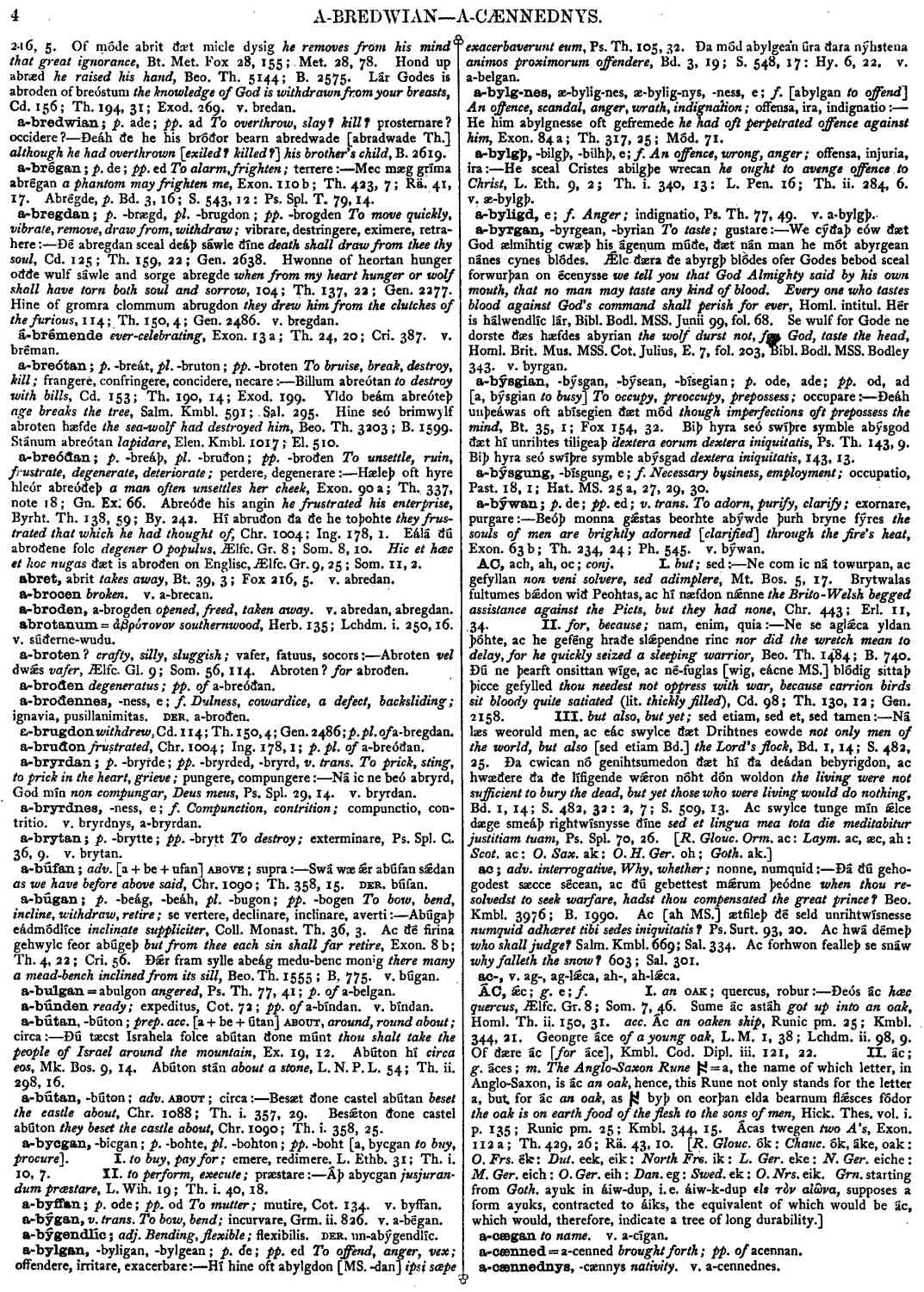
ÁC
- noun [ masculinefeminine ]
Grammar
Wright's OE grammar
§133;
§310;
§311;
§411;
§560;
§562;
an OAK ; quercus, robur
-
Ðeós ác
hæc quercus,
- Ælfc. Gr. 8; Som. 7, 46 .
-
Sume ác astáh
got up into an oak,
- Homl. Th. ii. 150, 31 .
-
acc.
Ác
an oaken ship.
- Runic pm. 25; Kmbl. 344, 21 .
-
Geongre áce
of a young oak,
- L. M. 1, 38; Lchdm. ii. 98, 9 .
-
Of ðære ác [
for áce]
,- Kmbl. Cod. Dipl. iii. 121, 22 .
Grammar
The Anglo-Saxon Rune
ᚪ = a, the name of which letter, in Anglo-Saxon, is ác an
oak, hence, this Rune not only stands for the letter a, but for ác an
oak, as
-
ᚪ byþ on eorþan elda bearnum flǽsces fódor
the oak is on earth food of the flesh to the sons of men,
- Hick. Thes. vol. i. p. 135; Runic pm. 25 ;
- Kmbl. 344, 15 .
-
Ácas twegen
two A's,
- Exon. 112 a; Th. 429, 26 ;
- Rä. 43, 10 .
R. Glouc. ók
: Chauc. ók, áke,
oak
:O. Frs. ék
: Dut. eek, eik
: North Frs. ik
:
L. Ger. eke
: N. Ger. eiche
: M. Ger. eich
:
O. Ger. eih
: Dan. eg
: Swed. ek
: O.
Nrs. eik
. Grn. starting from Goth. ayuk in áiw-dup, i.
e. áiw-k-dup nis εὶς τον αὶῶνα, supposes a form ayuks, contracted to
áiks, the equivalent of which would be ác, which would, therefore, indicate a tree
of long durability
.]
Entry information
Citation
Bosworth, Joseph. “ÁC.” In An Anglo-Saxon Dictionary Online, edited by Thomas Northcote Toller, Christ Sean, and Ondřej Tichy. Prague: Faculty of Arts, Charles University, 2014. https://bosworthtoller.com/137.
Checked: 1