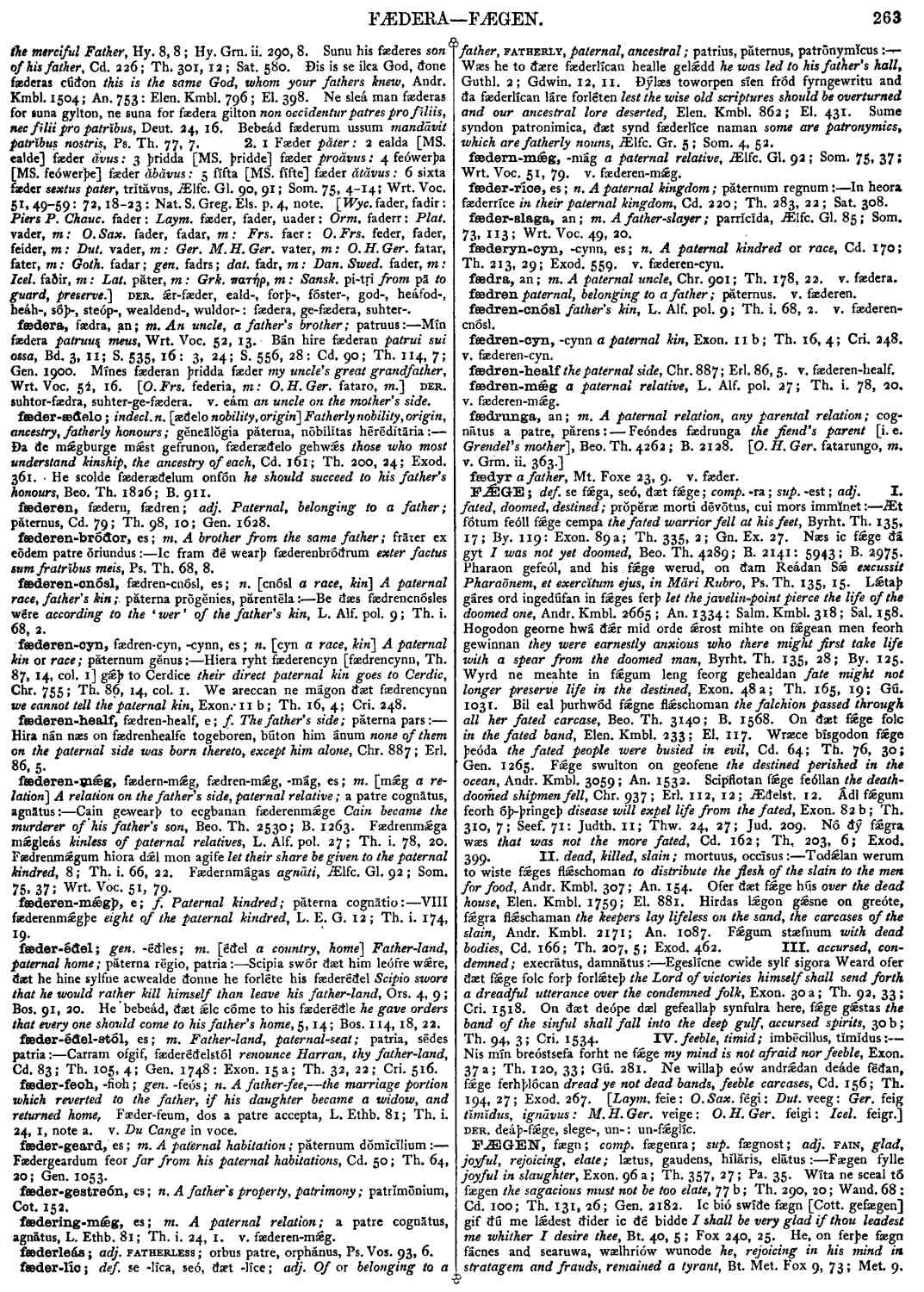
FÆGEN
- adjective
-
Fægen fylle
joyful in slaughter,
- Exon. 96 a ;
- Th. 357, 27;
- Pa. 35 .
-
Wíta ne sceal tó fægen
the sagacious must not be too elate,
77 b;- Th. 290, 20;
- Wand. 68 : Cd. 100 ;
- Th. 131, 26;
- Gen. 2182 .
-
Ic bió swíðe fægn [Cott. gefægen] gif ðú me lǽdest ðider ic ðé bidde
I shall be very glad if thou leadest me whither I desire thee,
- Bt. 40, 5 ;
- Fox 240, 25.
-
He, on ferþe fægn fácnes and searuwa, wælhriów wunode
he, rejoicing in his mind in stratagem and frauds, remained a tyrant,
- Bt. Met. Fox 9, 73;
- Met. 9 . 37.
-
Ferdon forþ ðonon, ferhþum fægne
they went forth thence, rejoicing in their minds,
- Beo. Th. 3270 ;
- B. 1633 .
-
Wǽron ealle fægen in firnum
they were all glad in their sufferings,
- Cd. 223 ;
- Th. 292, 3;
- Sat. 435 : Andr. Kmbl. 2084 ;
- An. 1043 .
-
Lyt monna wearþ lange fægen ðæs ðe he óðerne bewrencþ
few men rejoice long in what they have got by deceiving others,
- Prov. Kmbl. 34 .
-
Fægenra
more joyful,
- Bt. Met. Fox 12, 24;
- Met. 12, 12.
-
Fægnost
most joyful,
- Exon. 81 b ;
- Th. 306, 26;
- Seef. 13 .
Bosworth, Joseph. “FÆGEN.” In An Anglo-Saxon Dictionary Online, edited by Thomas Northcote Toller, Christ Sean, and Ondřej Tichy. Prague: Faculty of Arts, Charles University, 2014. https://bosworthtoller.com/9910.
Checked: 1