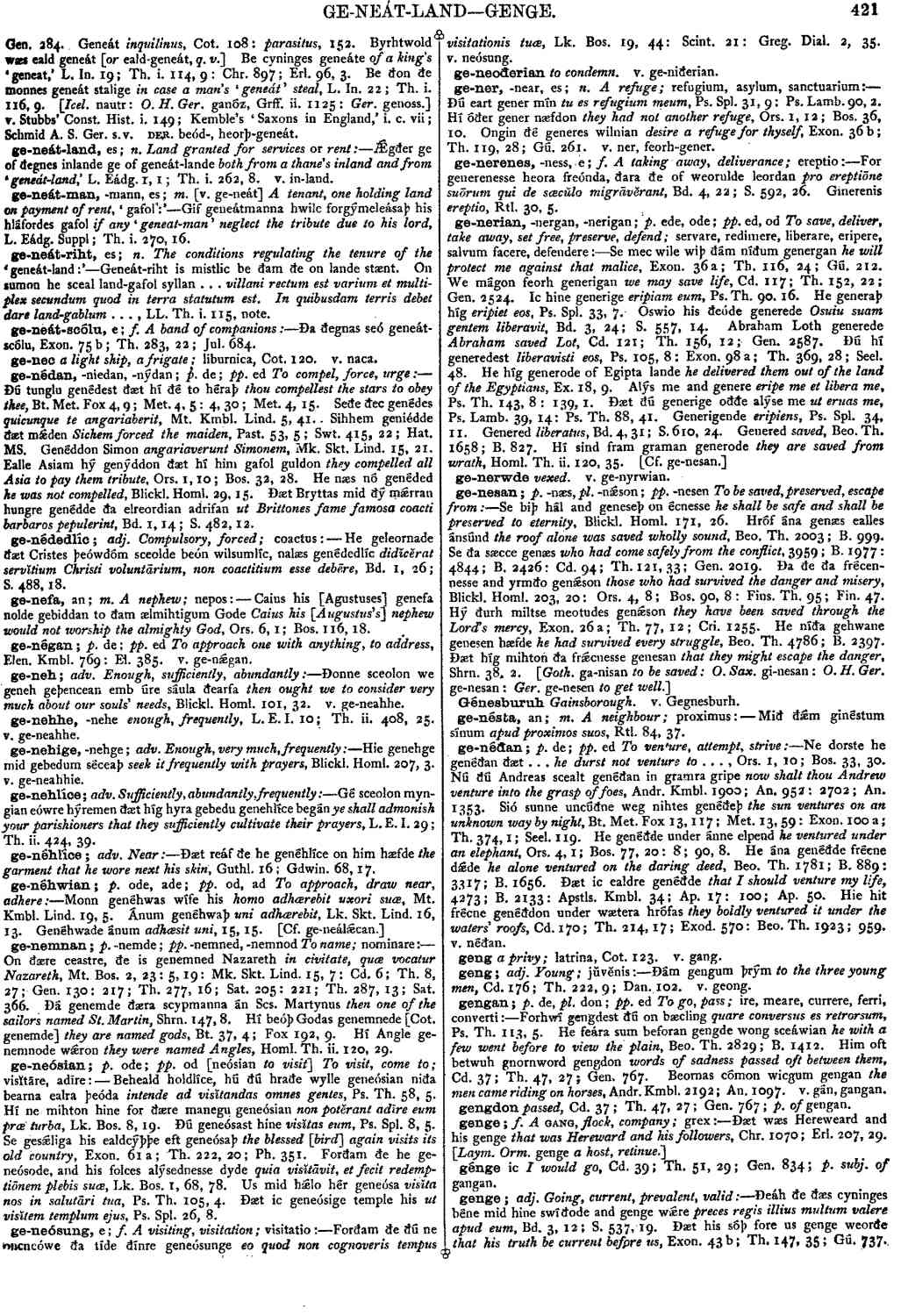
;f. A GANG, flock, company; grex :-- Ðæt wæs Hereweard and his genge that was Hereward and his followers, Chr. 1070; Erl. 207, 29. [Laym. Orm. genge a host, retinue.]
Linked entries (variants, parts of a paradigm or derived forms):
Cite the scanned version of the original dicionary like this:
Bosworth, Joseph. "genge." An Anglo-Saxon Dictionary: Based on the Manuscript Collections of the Late Joseph Bosworth. Ed. Thomas Northcote Toller. Oxford: Clarendon Press, 1898. 421.
;f. A gang. Substitute:genge, es; n. A band, company, troops :-- Heora ágene menn wolden hergon þone mynstre, þ̵ wæs Hereward and his genge, Chr. 1070; P. 205, 11. Hé sende æfter Leófríce eorle and æfter Síwarde eorle and bæd heora gencges. Hí him tó cómon mid medemum fultume, 1052; P. 175, 17. Se cining sende Ealdred mid genge, P. 176, 13. Hé gewende tó Brytlande and begeat him þǽr micel genge, 1055; P. 185, 38. [Hi flemden þe king and sloghen suithe micel of his genge, Chr. 1138; P. 266, 7.
;adj. Add: in season :-- Ðonne sceadd genge (not sceadd*-*genge under which the passage is given in Dict.) sý when shad is in season, Cht. Th. 544, 28. [Snou and haȝel heom is genge, O. and N. 1002. v. N. E. D. genge: Icel. gengr able to walk; passable; of money, good, current.] v. for-genge, forþ-genge, ge-genge, tíd-genge, un-genge, úþ-genge.