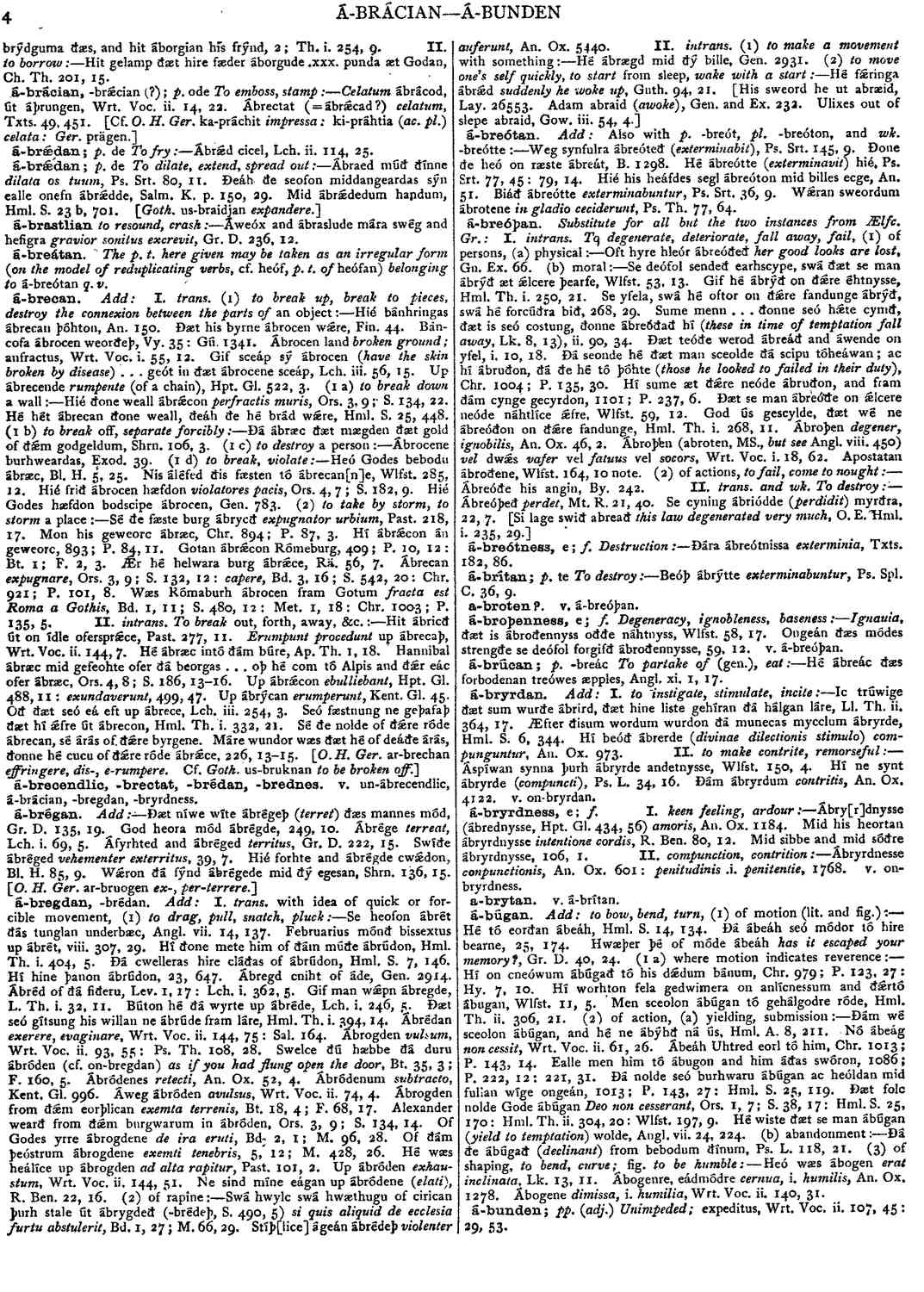
á-bregdan
- verb
-
Se heofon ábrét ðás tunglan underbæc,
- Angl. vii. 14, 137.
- Februarius mónð bissextus up ábrét, viii. 307, 29.
-
Hí ðone mete him of ðám múðe ábrúdon,
- Hml. Th. i. 404, 5.
-
Ðá cwelleras hire cláðas of ábrúdon,
- Hml. S. 7, 146.
-
Hí hine þanon ábrúdon,
- 23, 647.
-
Ábregd cniht of áde,
- Gen. 2914.
-
Ábréd of ðá fiðeru,
- Lev. 1, 17 : Lch. i. 362, 5.
-
Gif man wǽpn ábrégde,
- L. Th. i. 32, 11.
-
Búton hé ðá wyrte up ábréde,
- Lch. i. 246, 5.
-
Ðæt seó gítsung his willan ne ábrúde fram láre,
- Hml. Th. i. 394, 14.
-
Ábrédan
exerere, evaginare.
- Wrt. Voc. ii. 144, 75 : Sal. 164.
-
Abrogden
vulsum,
- Wrt. Voc. ii. 93, 55 : Ps. Th. 108, 28.
-
Swelce ðú hæbbe ðá duru ábróden (cf. on-bregdan)
as if you had flung open the door.
- Bt. 35, 3 ; F. 160, 5.
-
Ábródenes retecti, An. Ox. 52, 4, Ábródenum
subtracto,
- Kent, Gl. 996.
-
Áweg ábróden
avulsus,
- Wrt. Voc. ii. 74, 4.
-
Ábrogden from ðǽm eorþlican
exemta terrenis,
- Bt. 18, 4; F. 68, 17.
-
Alexander wearð from ðǽm burgwarum in ábróden,
- Ors. 3, 9 ; S. 134, 14.
-
Of Godes yrre ábrogdene
de ira eruti,
- Bd; 2, 1; M. 96, 28.
-
Of ðám þeóstrum ábrogdene
exemti tenebris,
- 5, 12; M. 428, 26.
-
Hé wæs heálíce up ábrogden
ad alta rapitur,
- Past. 101, 2.
-
Up ábróden
exhaustum.
- Wrt. Voc. ii. 144, 51.
-
Ne sind míne eágan up ábródene (
elati
),- R. Ben. 22, 16.
-
Swá hwylc swá hwælhugu of cirican þurh stale út ábrygdeð (-brédeþ, S. 490, 5)
si quis aliquid de ecclesia furtu abstulerit,
- Bd. 1, 27; M. 66, 29.
-
Stíþ[lice] ágeán ábrédeþ
violenter auferunt,
- An. Ox. 5440.
- Hé ábrægd mid ðý bille. Gen. 2931.
-
Hé fǽringa ábrǽd
suddenly he woke up.
- Guth. 94, 21.
-
Adam abraid (
awoke
),- Gen. and Ex. 232.
-
Ulixes out of slepe abraid,
- Gow. iii. 54, 4.
Bosworth, Joseph. “á-bregdan.” In An Anglo-Saxon Dictionary Online, edited by Thomas Northcote Toller, Christ Sean, and Ondřej Tichy. Prague: Faculty of Arts, Charles University, 2014. https://bosworthtoller.com/37384.
Checked: 0