deór
This might be just a supplemental entry adding to an entry in the Main Volume.
Related §§ in Wright's OE Grammar:
deór
brave. Add: [
v. N. E. D. dear, dere.]
This entry is on page:
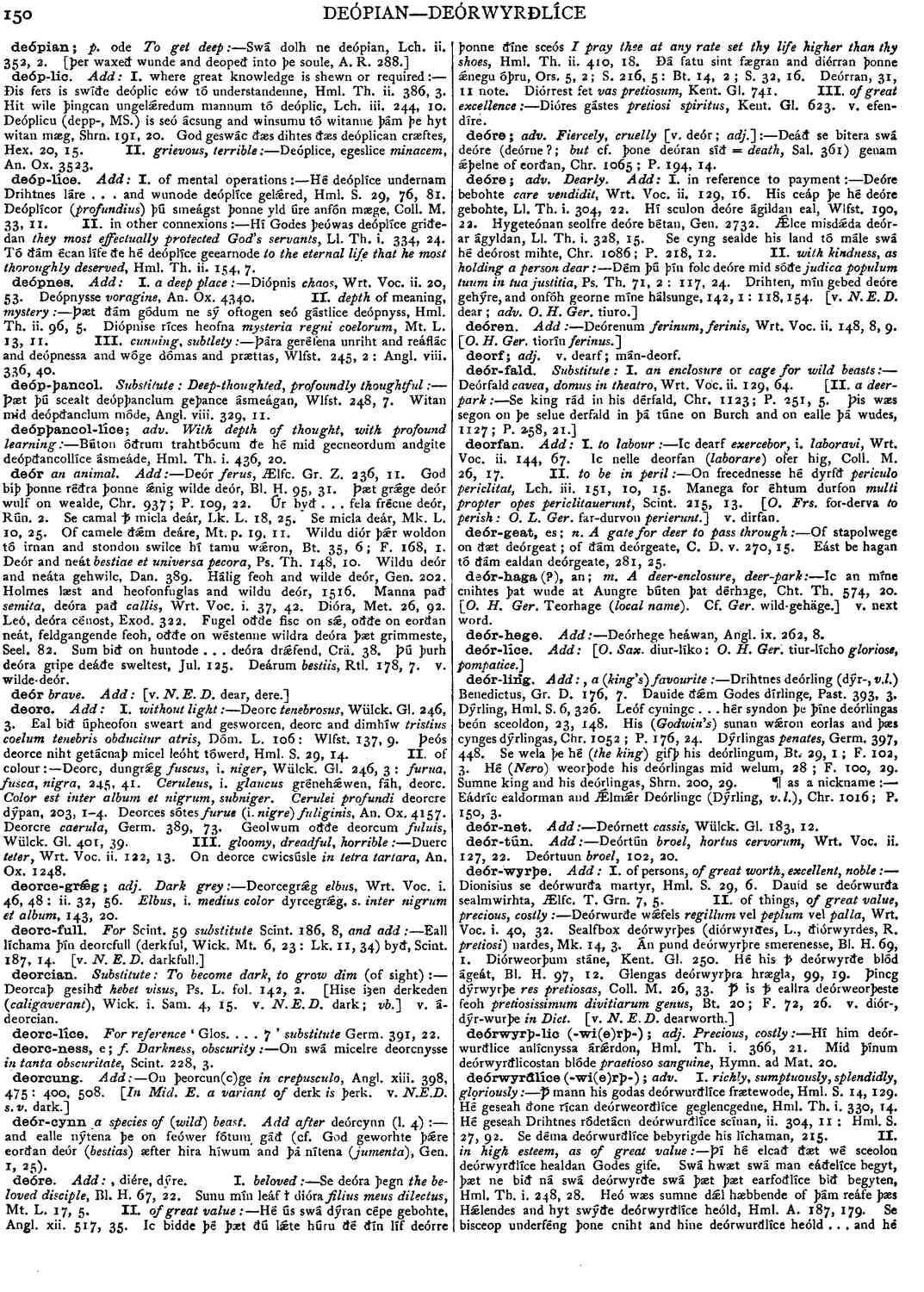
150 of the Supplement of the paper dictionary.
Browse the pages or
show/hide this scanned page.
Cite the scanned version of the original dicionary like this:- Toller, T. Northcote, and Joseph Bosworth. "deór." An Anglo-Saxon Dictionary: Based on the Manuscript Collections of the Late Joseph Bosworth : Supplement. Oxford: Clarendon Press, 1921. 15.
![]()
DEÓR
, diór, es; n. An animal, any sort of wild animal, a wild beast, DEER; mostly in contrast to domestic animals; fĕra, bestia :-- Is ðæt deór pandher háten the animal is called panther, Exon. 959; Th. 356, 16; Pa. 12. Ðæt is wrætlíc deór, hiwa gehwylces that is a curious beast, of every hue, 95 b; Th. 356, 29; Pa. 19. God geworhte ðære eorþan deór æfter hira hiwum, and ða nítenu on heora cynne fēcit Deus bestias terræ juxta spĕcies suas, et jumenta in genĕre suo, Gen. 1, 25.
deór
, diór, dýr; adj. [deór an animal]. I. brave, bold, as a wild beast; fortis, strēnuus :-- Se hálga wæs to hofe lǽded, deór and dómgeorn the holy one was led to the house, bold and virtuous, Andr. Kmbl. 2617; An. 1310: Exon. 108 b; Th. 414, 6; Rä. 32, 16. Nis mon in his dǽdum to ðæs deór there is not a man so bold in his deeds, Exon. 82 a; Th. 308, 17; Seef. 41. Ðæt wæs se deóra, Didĭmus wæs háten that was the bold one, he was called Didymus, Cd. 225; Th. 299, 1; Sat. 543.