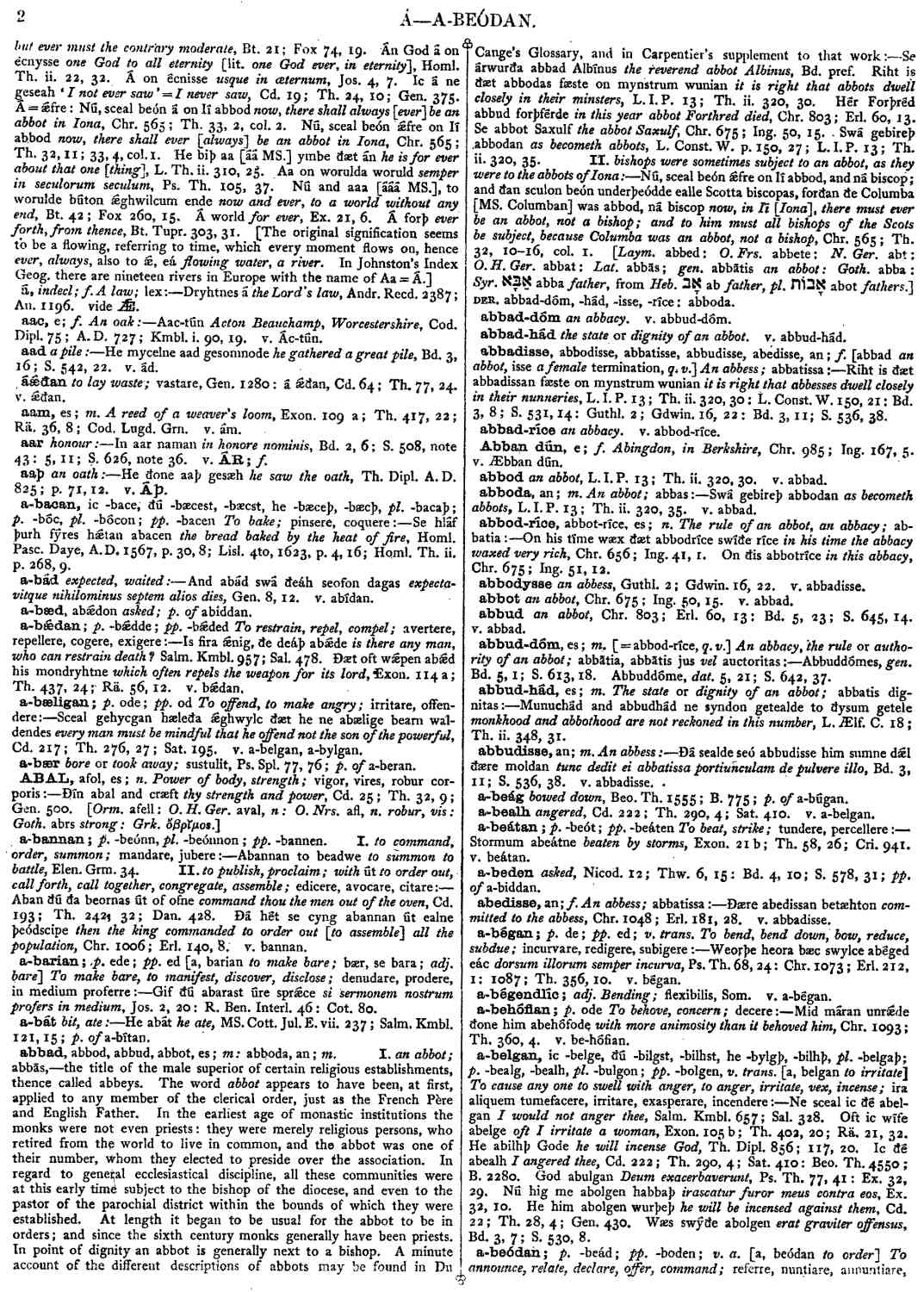
a-beódan
- verb [ strong ]
Grammar
Wright's OE grammar
§646;
To announce, relate, declare, offer, command; referre, nuntiare,
annuntiare,edicere, offerre, jubere
-
Ðæt he wolde ðæt ǽrende abeódan
that he would declare the errand,
- Ors. 4, 6; Bos. 86, 20 :
- Cd. 91; Th. 115 ,14 ;
- Gen. 1919: 200 ;
- Th. 248, 9 ;
- Dan. 510.
Linked entries
v.
a-boden.
Entry information
Citation
Bosworth, Joseph. “a-beódan.” In An Anglo-Saxon Dictionary Online, edited by Thomas Northcote Toller, Christ Sean, and Ondřej Tichy. Prague: Faculty of Arts, Charles University, 2014. https://bosworthtoller.com/46.
Checked: 1