BÁN
- noun [ neuter ]
Grammar
Wright's OE grammar
§5;
§133;
§285;
§292;
§343;
§562;
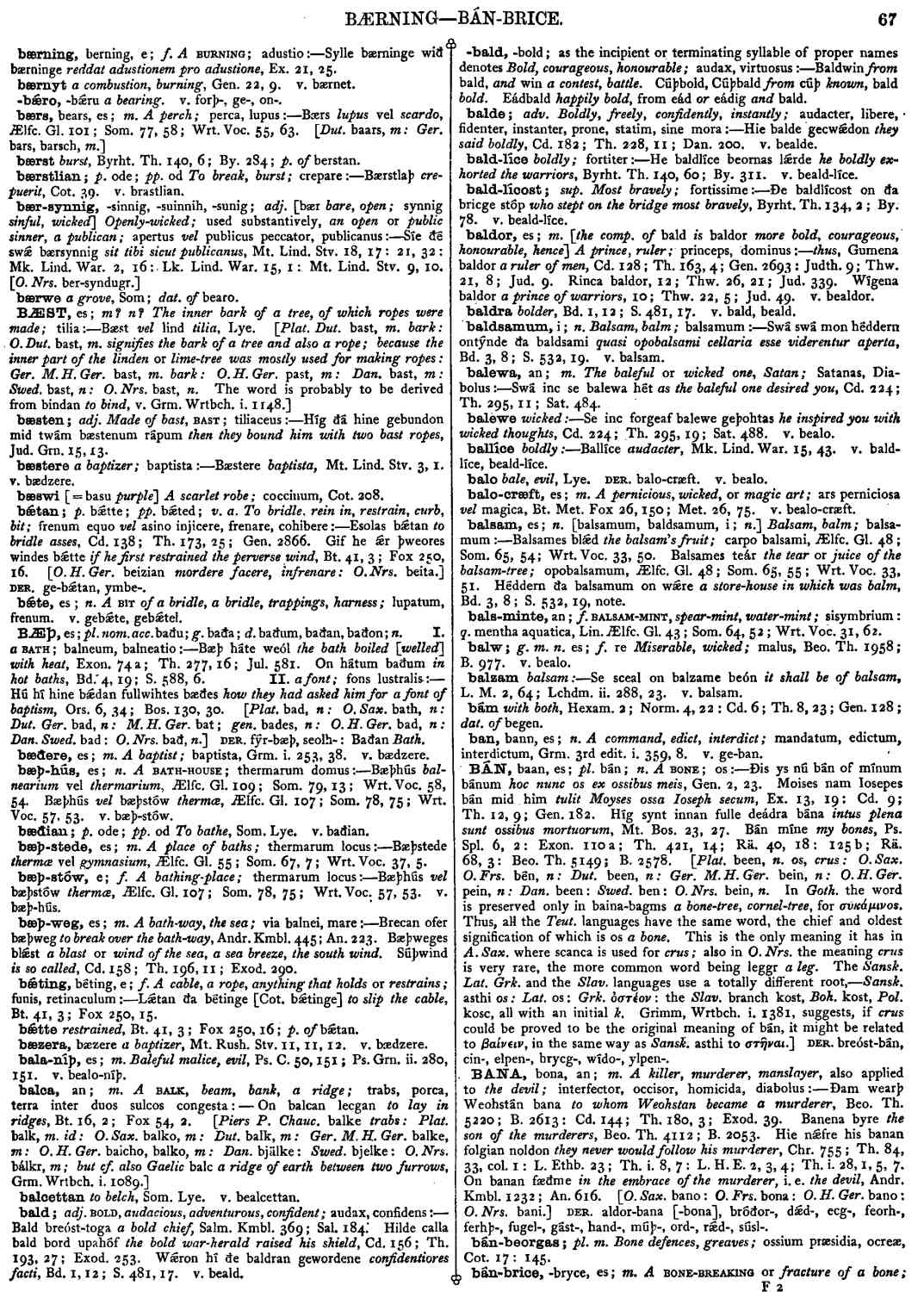
A BONE; os
-
Ðis ys nú bán of mínum bánum
hoc nunc os ex ossibus meis,
- Gen. 2, 23 .
-
Moises nam Iosepes bán mid, him
tulit Moyses ossa Ioseph secum,
- Ex. 13, 19 :
- Cd. 9; Th. 12, 9 ;
- Gen. 182 .
-
Híg synt innan fulle deádra bána
intus plena sunt ossibus mortuorum,
- Mt. Bos. 23, 27 .
-
Bán míne
my bones,
- Ps. Spl. 6, 2 :
- Exon. 110a; Th. 421, 14 ;
- Rä. 40, 18: 125b ;
- Rä. 68, 3 :
- Beo. Th. 5149 ;
- B. 2578 .
Etymology
Plat. been, n. os, crus
: O. Sax. O. Frs. bén, n
:
Dut. been, n
: Ger. M. H. Ger. bein, n
: O. H. Ger.
pein, n
: Dan. been
: Swed. ben
: O. Nrs. bein,
n.
In Goth. the word is preserved only in baina-bagms
a bone-tree, cornel-tree, for σνκάμινos
. Thus, all the
Teut. languages have the same word, the chief and oldest signification
of which is os a bone. This is the only meaning it has in A.
Sax. where scanca is used for crus; also in O. Nrs.
the meaning crus is very rare, the more common word being leggr a
leg. The Sansk. Lat. Grk. and the Slav. languages use
a totally different root,-Sansk. asthi os: Lat. os: Grk.
όστέoν: the Slav. branch kost, Boh. kost,
Pol. kosc, all with an initial k. Grimm, Wrtbch. i. 1381,
suggests, if crus could be proved to be the original meaning of bán, it
might be related to βαίνειν, in the same way as Sansk.
asthi to στήναι.]
Derived forms
Linked entries
v.
baan bán-wærc bán-ece ban-snacan.
Entry information
Citation
Bosworth, Joseph. “BÁN.” In An Anglo-Saxon Dictionary Online, edited by Thomas Northcote Toller, Christ Sean, and Ondřej Tichy. Prague: Faculty of Arts, Charles University, 2014. https://bosworthtoller.com/2958.
Checked: 1