Cite the scanned version of the original dicionary like this:
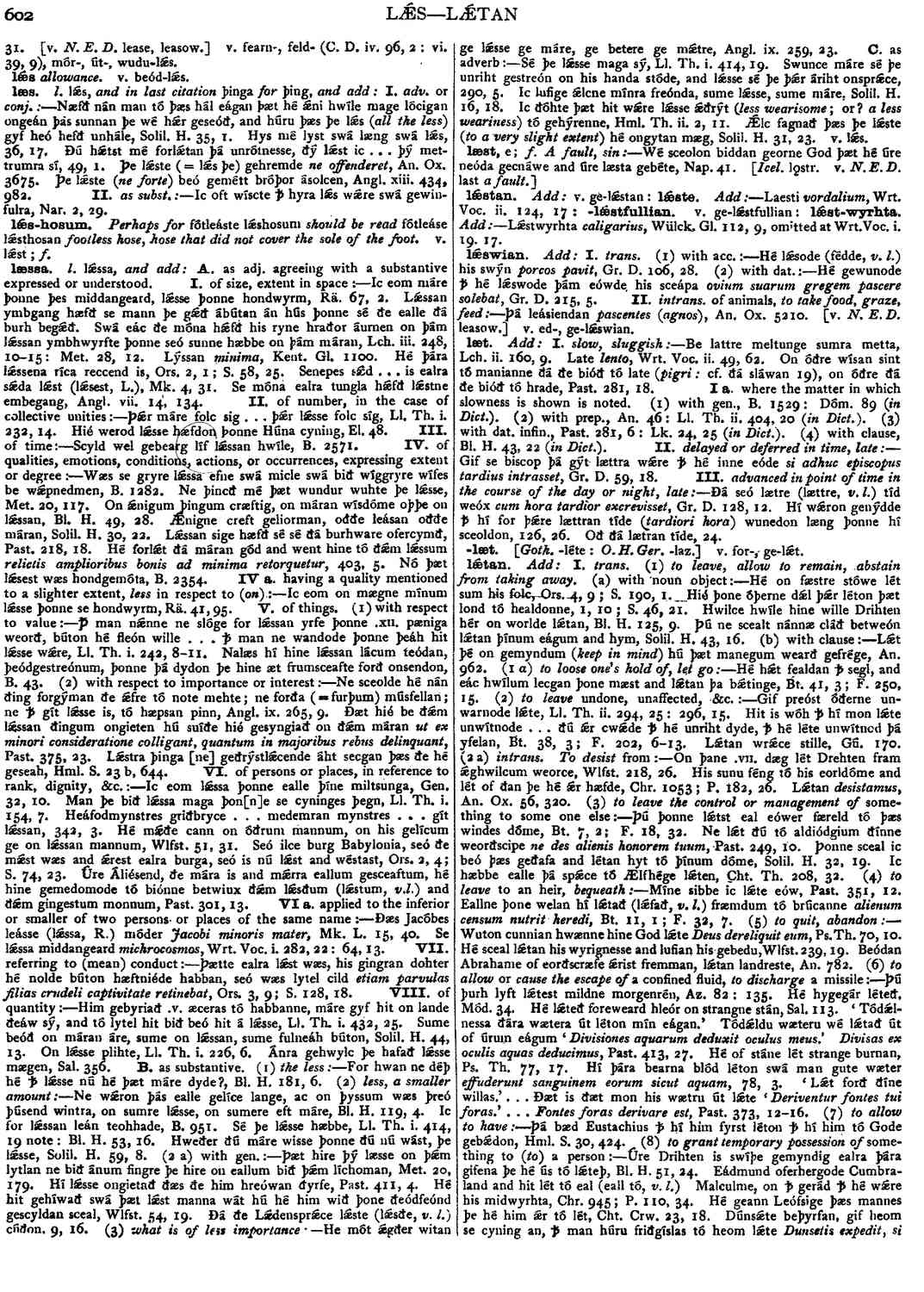
Toller, T. Northcote, and Joseph Bosworth. "lǽs." An Anglo-Saxon Dictionary: Based on the Manuscript Collections of the Late Joseph Bosworth : Supplement. Oxford: Clarendon Press, 1921. 602.
, we, e; f. A pasture, leasow [still found in local names] :-- Lǽs pascua; gemǽne lǽs compascuus ager, Ælfc. Gl. 96; Som. 76, 44, 47; Wrt. Voc. 53, 51, 54. Se wudu and seó lǽs is gemǽne tó ðám án and twentigum hídum, Cod. Dip. Kmbl. v. 319, 28. Sceáp lǽswe ðínre oves pascuæ tuæ, Ps. Spl. 73, 1: 78, 14: 94, 7: 99, 4: 22, 1. Hit is gescræpe on lǽswe sceápa and neáta alendis apta pecoribus ac jumentis, Bd. 1, 1; S. 473, 14. Ic wylle hí healdan on genihtsumere lǽse I will keep them in an abundant pasture, Homl. Th. i. 242, 15. On gemǽnre lǽse, L.
, e; f. A letting [of blood] :-- Blódes lǽs bloodletting, L. M. 3, 47, cont; Lchdm. ii. 302, 23. Cf. Þurh ða blódlǽse geclǽnsad, 2, 23; Lchdm. ii. 210, 18; and v. blód-læswu, lǽtan: cf. ǽs and etan.
;adv. also used in conjunctional phrases and as a noun. Less, lest :-- Hió mé lytle læs láðe woldan ðisses eorþweges ende gescrífan paulominus consummaverunt me in terra, Ps. Th. 118, 87. Nóht ðon læs nihilominus, Bd. 2, 14; S. 516, 6. Nóhte ðon læs, 3, 6; S. 528, 10. Nóhte ðý læs unáræfnendlíc non minus intolerabile, 5, 12; S. 627. 38. Cýð ðis folc ðæt hig ne gán ofer ða gemǽro ðé læs hig swelton contestare populum ne forte velit transcendere terminos et pereat, Ex. 19, 21, 24: Ps. Th. 68, 14. Ðé lea ne, Kent. Gl. 161.