neáh
- adverb
-
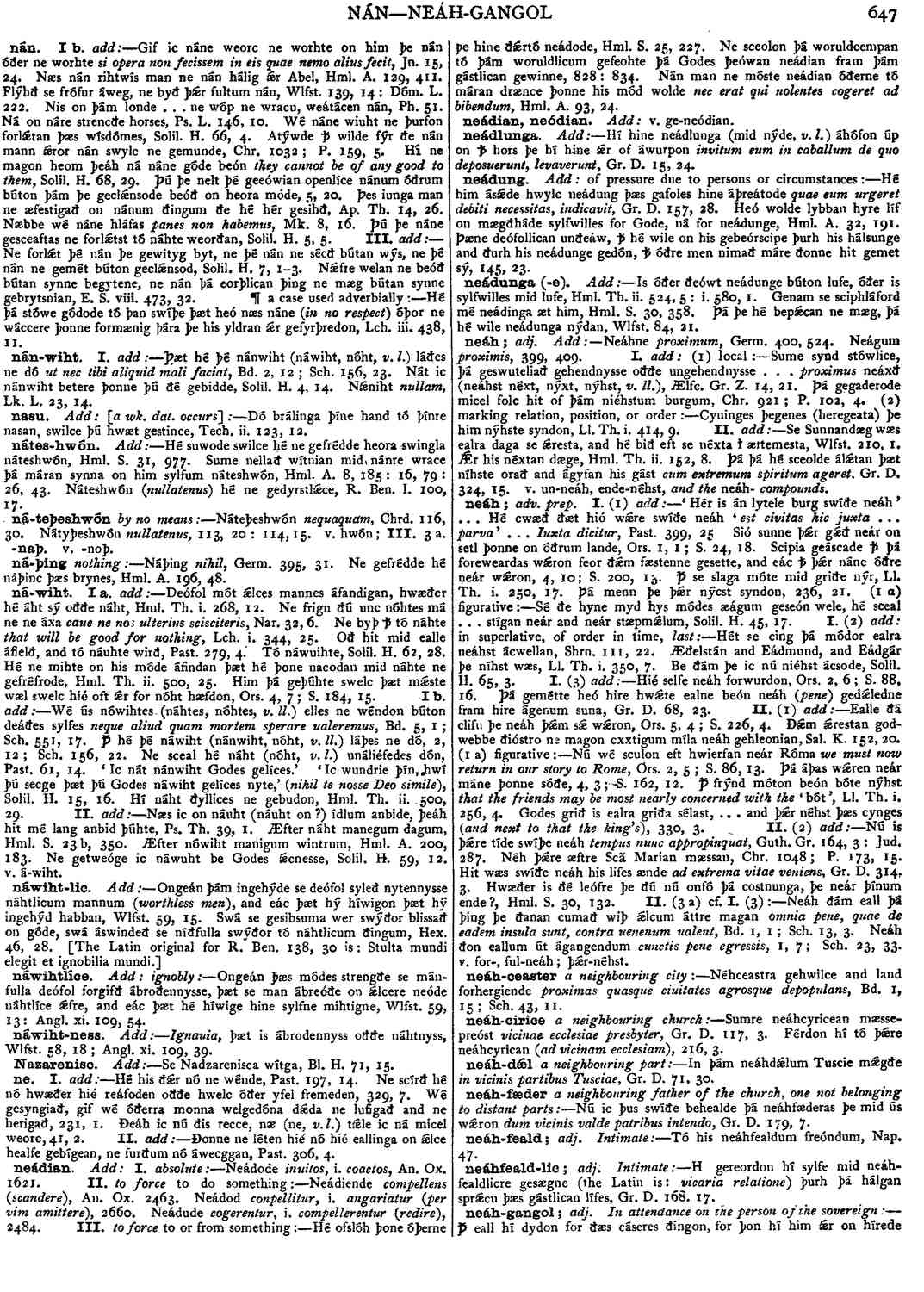
'Hér is án lytele burg swíðe neáh' . . . Hé cwæð ðæt hió wǽre swíðe neáh '
est civitas hic juxta . . . parva' . . . Iiuxa dicitur,
- Past. 399, 25
-
Scipia geáscade ꝥ þá foreweardas wǽron feor ðǽm fæstenne gesette, and eác ꝥ þǽr náne óðre neár wǽron,
- 4, 10; S. 200, 13.
-
Þ se slaga móte mid griðe nýr,
- Ll. Th. i. 250, 17.
-
Þá menn þe þǽr nýcst syndon,
- 236, 21.
- (I a) figurative :-- Sé ðe hyne myd hys módes æágum geseón wele, hé sceal . . . stígan neár and neár stæpmǽlum, Solil. H. 45, 17.
-
Hét se cing þá módor ealra neáhst ácwellan,
- Shrn. III, 22.
-
Æðelstán and Eádmund, and Eádgár þe níhst wæs,
- Ll. Th. i. 350, 7.
-
Be ðám þe ic nú niéhst ácsode,
- Solil. H. 65, 3.
-
Hié selfe neáh forwurdon,
- Ors. 2, 6 ; S. 88, 16.
-
Þá gemétte heó hire hwǽte ealne beón neáh
(pene)
gedǽledne fram hire ágenum suna,- Gr. D. 68, 23.
-
Ealle ðá clifu þe neáh þǽm sǽ wǽron,
- Ors. 5, 4 ; S. 226, 4.
-
Ðǽm ǽrestan godwebbe ðióstro na magon cxxtigum míla neáh gehleonian, Sal. K. 152, 20. (l a) figurative :-- Nú wé sculon eft hwierfan neár Róma
we must now return in our story to Rome,
- Ors. 2, 5 ; S. 86, 13.
-
Þá áþas wǽren neár máne þonne sóðe,
- 4, 3; S. 162, 12.
-
Þ frýnd móton beón bóte nýhst
that the friends may be most nearly concerned with the
'bót',- Ll. Th. i. 256, 4.
-
Godes grið is ealra griða sélast, . . . and þǽr néhst þæs cynges (
and next to that the king's
),- 330, 3.
-
Nú is þǽre tíde swíþe neáh
tempus nunc appropinquat,
- Guth. Gr. 164, 3 : Jud. 287.
-
Néh þǽre æftre Scã Marian mæssan,
- Chr. 1048; P. 173, 15.
-
Hit wæs swíðe neáh his lifes ænde
ad extrema vitae veniens.
- Gr. D. 314. 3.
-
Hwæðer is ðé leófre þe ðú nú onfó þá costnunga, þe neár þínum ende?,
- Hml. S. 30, 132.
-
Neáh ðám eall þá þing þe ðanan cumað wiþ ǽlcum áttre magan
omnia pene, quae de eadem insula sunt, contra uenenum ualent,
- Bd. l, I ; Sch. 13, 3.
-
Neáh ðon eallum út ágangendum
cunctis pene egressis,
i.- 7, Sch. 23, 33.
Bosworth, Joseph. “neáh.” In An Anglo-Saxon Dictionary Online, edited by Thomas Northcote Toller, Christ Sean, and Ondřej Tichy. Prague: Faculty of Arts, Charles University, 2014. https://bosworthtoller.com/55797.
Checked: 0